





Coimbra presents you with a paradox: it’s one of Portugal’s most ancient cities, yet thanks to its university, it pulses with youthful energy. Once the medieval capital of Portugal, it sits perched on a hill overlooking the Mondego River, its winding streets whispering centuries of secrets.
Because of its university life, Coimbra is never stodgy — cafés, student strolls, fado music in hidden alleys. You’ll also get that Harry Potter feeling when you see the university seniors walking the streets in their black robes (minus the wands).
Less than 90 minutes by car from Tiny Escape, you can easily spend five hours exploring this hilltop treasure and still have time to lounge by the bio-pool.

Across the river: Ponte Pedro e Inês
You will likely park near the river so it’s a good place to start your adventure. Begin by crossing the footbridge Ponte Pedro e Inês. It offers sweeping vistas of Coimbra’s terraced rooftops climbing the hill, mirrored in the Mondego. The play of light, colors, and the river make for a charming panorama.


Stroll the downtown: shops, patios, and surprises
Start your Coimbra visit by wandering in the Baixa (lower town) and Almedina area, where shops, cafés, and restaurants hug narrow streets and stone staircases. There’s a romantic sort of charm in ducking into a patio, sipping a coffee, watching locals drift by.


A few must-sees in downtown:
- Monastery of Santa Cruz: This is one of the city’s grand ecclesiastical landmarks. Its plaza is a relaxed spot to pause and soak in the architecture and local bustle.
- Jardim de Manga: One of my favorites. With curved bridges, slender towers, and a pond whose reflections echo Escher-style geometry, it feels both magical and mysterious.
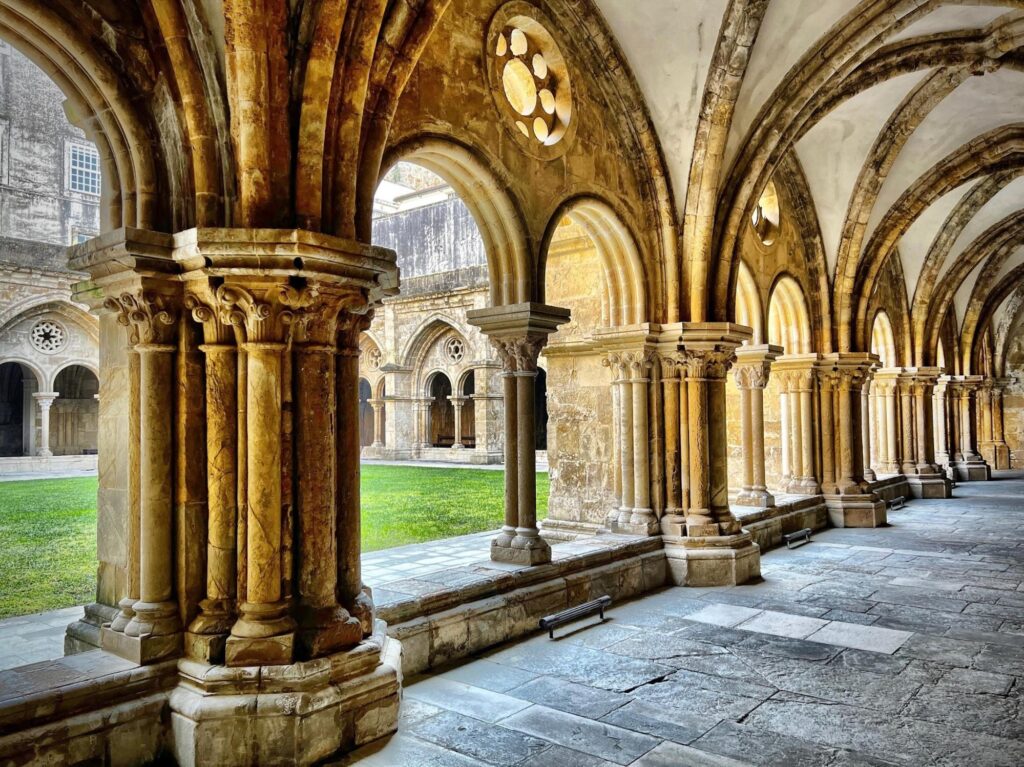
- Old Cathedral (Sé Velha): Step inside and you’ll be greeted by graceful cloisters of arches and columns, quiet corners, and centuries of history.
Wandering the downtown is part of the joy — you never quite know when you’ll stumble into a hidden chapel, a crooked stairway, or a local artisan shop. When your ready to move on, be sure you have your water bottle because the next stop is at the top of the hill.
A deeper dive: The University of Coimbra & its library

A bit of history & context
- The University of Coimbra is among the oldest universities in Europe from the 13th century and the oldest in the Portuguese-speaking world.
- The university buildings sit at the top of the hill (the “Alta” region), commanding views over the city and river below.
The legendary Biblioteca Joanina
If there’s one room that makes visitors catch their breath, it’s the Joanina Library (Biblioteca Joanina).
- Commissioned by King João V in the early 18th century (1717–1728), it’s a Baroque masterpiece full of gilded woodwork, trompe-l’oeil ceiling paintings, ornate shelves, and sumptuous detail.
- It holds tens of thousands of rare volumes (some dating to the 16th century) and is often called one of the most beautiful libraries in the world.
- To protect the books from insects, a small colony of bats lives in the library and helps keep pests at bay (they only emerge at night).
- Photography inside is generally not allowed, so be ready to let the memory settle in your mind.
When you tour the library, take time also to admire the surrounding “Paço das Escolas” (Palace of Schools) and the university tower rising above.


The Quinta das Lágrimas: a garden of heartbreak turned beauty
“Quinta das Lágrimas” literally means “Estate of Tears.” The name evokes sorrow—but the place is more likely to make you smile (and sigh).
The Legend of Pedro and Inês
Legend goes that Inês de Castro was the beloved of Prince Pedro (later King Pedro I). Their love was forbidden by Pedro’s father, King Afonso IV. Inês was tragically murdered in 1355. After Pedro became king, he declared that Inês had been his lawful queen, had her exhumed, and ordered her assassins punished in brutal fashion.
The Quinta is said to have been one of the places where their secret meetings occurred. The water channels in the garden allegedly carried letters between them, and the streams and little pools now echo memory of that romance.
What you’ll see
- Ruins, partial walls, and fragments of old structures linger amid lush greenery, giving the garden a poetic air.
- Bamboo groves, small ponds, reflecting pools, shaded walkways — all weaving together in a softly meditative layout.
- Sculpted features, stone benches, statues, and pathways that invite lingering.
- The “Fonte dos Amores” (Fountain of Lovers) is a romantic highlight.
- The ambient quiet and interplay of water, foliage, and stone make it a peaceful escape from the busy town.
Visiting Quinta das Lágrimas gives a chance to feel Coimbra’s romantic undercurrent, beyond its academic reputation.

Sample itinerary: about five hours in Coimbra
Here’s a rough outline to help you make the most of your time:
- Arrive & park (if by car).
- Cross to Ponte Pedro e Inês for a scenic view and walk along the riverbanks.
- Downtown stroll: shops, cafés, the Monastery of Santa Cruz and plaza.
- Jardim de Manga — linger in its bridges and reflections.
- Old Cathedral (Sé Velha) — explore the cloisters.
- Head uphill to the University quarter: visit the Joanina Library and tour the university complex.
- Quinta das Lágrimas — finish your tour in the romantic garden, unwind.
- Optionally, linger for a sunset drink on a terrace, soak in views — then depart back to Tiny Escape.
Depending on your pace, you might skip or shorten some stops, but this gives you a nice balance of history, nature, architecture, and romance.
Why you will love it
Coimbra is a jewel perched on a hill — academic, ancient, poetic, and alive. It’s the kind of place you’ll wander through and discover new corners each time. For anyone at Tiny Escape looking to escape for the day (with a little extra reserved for pool-time), it’s just the right size, rich but not overwhelming — and full of memories waiting to be made.